The Digital Fortress: A Comprehensive Analysis of E-Commerce Content Protection, SEO Preservation, and Anti-Fraud Architectures
Learn how to protect your e-commerce store from content theft, preserve your SEO rankings, and prevent fraud with our comprehensive guide. Discover the best strategies and tools to safeguard your digital assets.
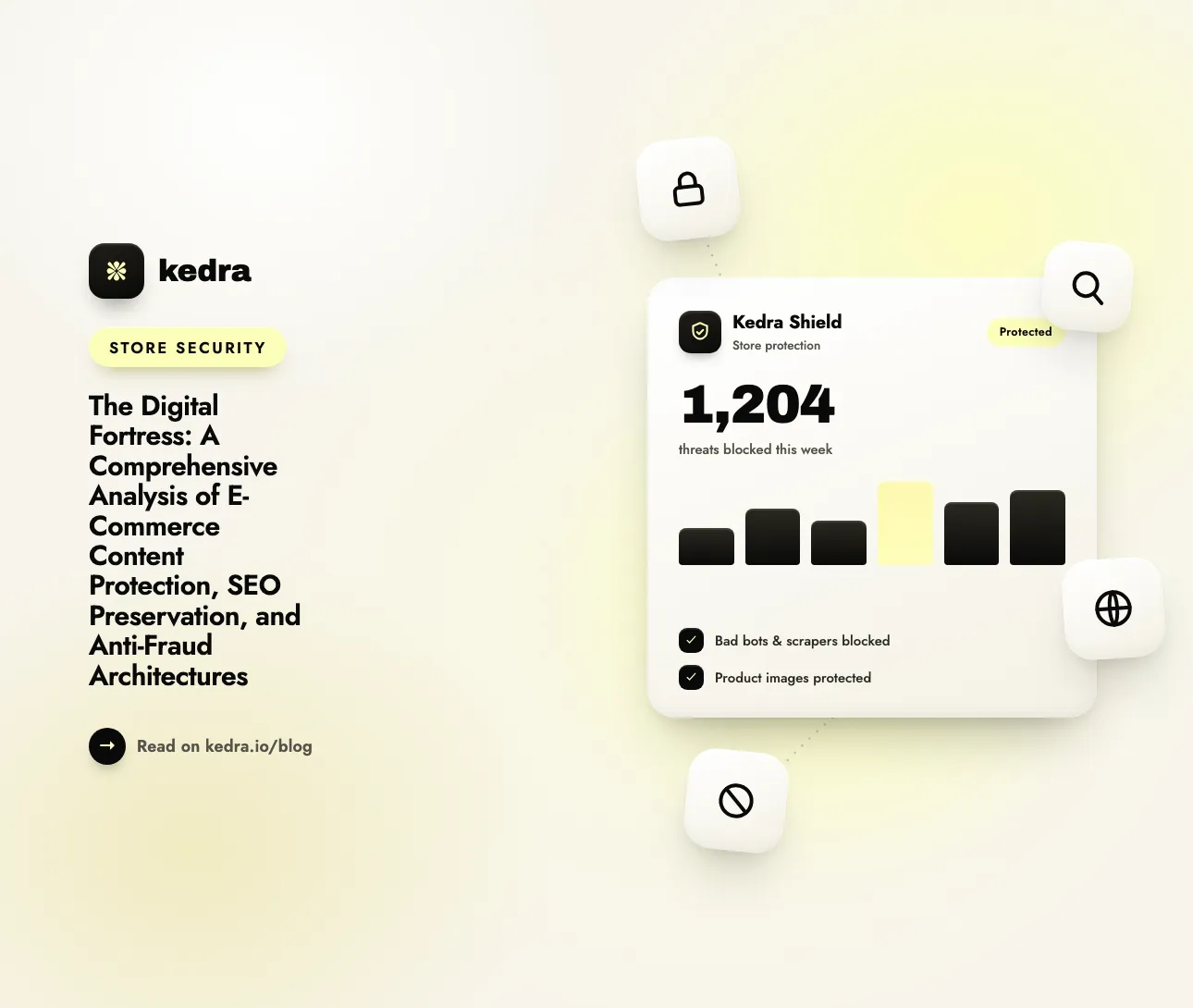
E-commerce content protection means safeguarding the digital assets that now carry much of your store’s value - product photography, descriptions, and brand voice - against casual copycats and automated scrapers. This guide breaks down how content theft erodes SEO rankings and revenue, and how layered defenses like UI protection, geo-blocking, and VPN filtering keep your storefront secure.
1. The Vulnerable Storefront: The New Economics of Digital Assets
In the rapidly evolving landscape of global e-commerce, the definition of “inventory” has fundamentally shifted. Historically, a merchant’s value was tied to physical stock. Today, however, the digital representation of those goods-the high-resolution photography, the meticulously crafted product descriptions, and the unique brand voice-constitutes a massive portion of a company’s equity. Unlike physical inventory, digital assets are uniquely vulnerable to instantaneous, cost-free replication. The phenomenon of content theft poses an existential threat to the profitability and visibility of online retailers.
The scale of this threat is quantifiable and staggering. Recent data indicates that the global e-commerce sector loses approximately $48 billion annually to various forms of fraud (see ecommerce fraud stats and more fraud stats). While payment fraud often grabs headlines, intellectual property (IP) theft acts as a silent killer. For a merchant, the website is the primary engine of revenue. When that engine is cloned, the ramifications extend far beyond copyright infringement-they ripple into Search Engine Optimization (SEO) rankings, customer trust, and operational costs.
This report serves as a definitive guide for store owners. It explores the mechanisms of digital theft and provides a rigorous analysis of advanced defensive strategies-from disabling right-click functionality to implementing sophisticated geo-blocking. Central to this analysis is the evaluation of integrated security architectures like Kedra Shield. By consolidating disparate protective measures into a unified defensive perimeter, merchants can safeguard their content and revenue streams.
1.1 The Anatomy of Digital Theft
1.1.1 The Opportunistic Competitor (Casual Theft)
At the lowest level of sophistication lies the “casual thief.” This is typically a human actor who lacks the resources to create original content. They visit a successful store and simply copy high-converting descriptions or images (see how to disable right-click). While a single instance may seem trivial, the cumulative effect creates a “sea of sameness” where the original innovator becomes indistinguishable from imitators.
1.1.2 The Automated Scraper (Systematic Harvesting)
At the higher end is automated scraping. Bots systematically crawl websites to extract data at scale (see web scraping for e-commerce). These bots harvest product listings and pricing to power “shadow stores” or dynamic pricing algorithms that undercut the original merchant (see price scraping risks). The web scraping market is projected to reach $2 billion by 2030, driven largely by e-commerce competitive intelligence (see web scraping market report). For a closer look at the mechanics, see how thieves steal your product descriptions.

2. The SEO Ecosystem: Why Content Uniqueness is Non-Negotiable
The relationship between content protection and SEO is critical. Organic search traffic relies on Google’s algorithms recognizing a store’s pages as authoritative and unique. Content theft disrupts this, leading to “ranking dilution.”
2.1 Demystifying the “Duplicate Content Penalty”
A pervasive fear is the “duplicate content penalty.” Google has stated that there is technically no “penalty” for non-malicious duplication (see demystifying duplicate content). However, the consequences are functionally similar. When crawlers encounter identical content, they must decide which version is “canonical.” If a site with higher domain authority scrapes a smaller store’s content, Google may index the larger site as the source, causing the victim to disappear from search results (see duplicate content penalties).
2.2 The Mechanism of Ranking Dilution
When unique text is stolen, the “uniqueness” signal that tells search engines “This page offers value” is nullified (see scraping and SEO). Tools that inhibit text selection and right-click copying serve as a dam against this duplication. By securing content with tools like Kedra Shield, merchants protect their SEO investment. Understand how content scraping silently destroys search rankings before it dilutes yours.
3. The First Line of Defense: User Interface (UI) Protection
The first layer of defense involves UI protections designed to deter the casual thief, primarily by disabling right-click context menus.
3.1 The “Right-Click Disable” Debate
Critics argue that disabling right-click violates user expectations (see right-click security impact). However, in e-commerce, this measure is about risk management. It stops the impulse theft of images and text. As noted by security discussions, while it doesn’t stop a hacker, it effectively deters the “lazy” thief who simply wants to save an image (see how to disable right-click). Our practical guide covers disabling right-click to protect images on Shopify step by step.
3.2 Technical Implementation
Effective UI protection involves:
- Context Menu Suppression: preventing the “Save Image As” option.
- Text Selection Disabling: preventing users from highlighting and copying descriptions (see prevent content theft app).
- Drag-and-Drop Prevention: stopping users from dragging images to their desktop (see how to disable drag and drop).
For merchants investing in custom photography, these barriers are essential to prevent their assets from proliferating on third-party marketplaces (see Reddit discussion on disabling right-click).
4. Advanced Perimeter Defense: Geo-Blocking and Traffic Filtering
The modern threat landscape is global. For many merchants, traffic from regions they do not service is a liability, often bringing high rates of fraud and bot activity (see geo-blocking for network security).
4.1 Geo-Blocking as a Strategic Asset
- Fraud Reduction: Blocking traffic from high-risk countries prevents fraudsters from testing stolen cards on the site (see geo-blocking for business).
- Regulatory Compliance: It ensures compliance with international sanctions by blocking access from restricted jurisdictions (see OFAC sanctions).
- Resource Optimization: Blocking non-convertible traffic reduces server load and cleans up analytics data (see geo-blocking recommendations).
5. The Anonymity Vector: Managing VPNs and Proxies
Sophisticated attackers use VPNs and proxies to mask their location.
- The Fraudster’s Tool: Criminals use proxies to bypass location-based fraud filters (see blocking VPN and proxy users).
- The Scraper’s Tool: Bots use rotating proxies to avoid IP bans while harvesting data (see proxies in e-commerce).
Kedra Shield incorporates robust VPN blocking. Blocking known data-center IPs (often used by cheap bots) can significantly reduce the volume of automated attacks and chargebacks (see blocking VPNs and proxies).
6. The Psychological Layer: Tab Protection
In the attention economy, retaining user focus is vital. “Tab hoarding” behavior also introduces security risks like “tabnabbing.”
6.1 Blurring Content for Security
A novel feature is blurring website content when the user switches tabs.
- Privacy: This protects sensitive data on the screen from “shoulder surfing” in public spaces (see protecting sensitive data).
- Anti-Tabnabbing: Visual changes signal the page is “paused,” deterring phishing scripts that attempt to swap the page content while inactive (see tabnabbing threat).
- Re-engagement: Dynamic tab titles (e.g., “Come back!”) combined with the un-blur effect upon return create a micro-interaction that can reduce cart abandonment (see inactive tab features).
7. Integrated Security Solutions: The Kedra Shield Approach
The best practice in e-commerce security favors consolidation. Piecemeal solutions lead to code conflicts and performance drag.
Kedra Shield offers a unified defensive perimeter:
- Layer 1 (Network): Geo-Blocking and City Blocking stop high-risk traffic at the gate.
- Layer 2 (Identity): VPN/Proxy Blockers and Bot Detection filter out anonymized threats (see blocking proxies from online stores).
- Layer 3 (UI): Right-Click/Copy Disable prevents casual theft (see prevent Kedra Shield app).
- Layer 4 (Session): Content Blurring protects privacy and re-engages users.
See the complete Kedra Shield Shopify content-protection toolkit and how these layers combine into one perimeter.
Frequently Asked Questions
Is there really a “duplicate content penalty” if my content gets copied?
No. Google says there’s no penalty for non-malicious duplication, but the outcome can be just as harmful. When crawlers find identical content, they choose one canonical version. If a higher-authority site copies a smaller store, Google may index the copy as the source and drop the original from results.
Does disabling right-click actually protect my store?
It won’t stop a determined hacker, but it effectively deters casual, opportunistic theft. Disabling right-click, text selection, and drag-and-drop removes the easiest ways to grab images and descriptions. In e-commerce this is risk management - raising the effort required enough to discourage the lazy copycat.
How does geo-blocking help beyond stopping fraud?
Geo-blocking blocks traffic from regions you don’t serve, which reduces fraudulent card testing, supports compliance with sanctions on restricted jurisdictions, and optimizes resources by cutting non-convertible traffic. That last benefit also cleans up your analytics data and lowers the server load caused by bots and scrapers.
Why should I block VPNs and proxies on my store?
Fraudsters use proxies to bypass location-based fraud filters, and scraper bots use rotating proxies to dodge IP bans while harvesting data. Blocking known data-center IPs and anonymized connections significantly reduces automated attacks and chargebacks, closing an anonymity vector that both criminals and content thieves rely on.
Why choose an integrated security app over separate tools?
Piecemeal solutions cause code conflicts and performance drag. An integrated approach consolidates network filtering, VPN/proxy and bot detection, UI protection, and session-level blurring into one coordinated perimeter. That prevents scripts from fighting each other and closes the coverage gaps that appear when you stack unrelated tools.
Secure Your Store Today
The digital environment is predatory. Content theft is a direct transfer of value from the creator to the imitator. By implementing tools like Kedra Shield, merchants do more than just protect their text and images; they protect their SEO rankings, their revenue, and their brand integrity.
Don’t wait for your content to be stolen. Install Kedra Shield today and build your digital fortress.