To show payment methods by currency on Shopify, activate the local methods your Shopify Payments account supports; Shopify shows each one only for the right country and currency (iDEAL | Wero needs a Dutch address and EUR). Then use a checkout rules app to hide methods that can’t charge in the shopper’s currency and rank local favorites first.
Getting this right matters because the wrong list costs conversions even when the right method is somewhere on it. Stripe data shows that even one geographically irrelevant payment method can decrease conversion by up to 15% (Stripe, June 4, 2026). A store selling in euros, zloty, and Swiss francs from one Shopify admin needs a short, familiar list for each currency, not one global menu of every method it has ever activated.

Table of Contents
- What does showing payment methods by currency mean?
- Why does the checkout currency change which payment methods work?
- Which payment methods should each currency show, hide, or put first?
- What does Shopify already filter by currency, and what is left to you?
- Should you target payment rules by currency, country, or Shopify market?
- How do you set up payment methods by currency without code?
- What mistakes break currency-based payment rules?
- Frequently Asked Questions
What does showing payment methods by currency mean?
Showing payment methods by currency means showing, hiding, and ordering checkout payment methods according to the currency a shopper pays in, so each market sees the local options it trusts and none it cannot use. It connects two settings you already manage: the currency set for each market under Markets and the methods activated under Settings → Payments.
Currency matters because Shopify gates its own local methods on both country and currency: “Each method is available only when a customer is in a supported country and selects an eligible currency” (Shopify Help Center, Local payment methods).
Currency also sets expectations. Stripe reports that 76% of customers choose to pay in their local currency when given the option (Stripe, June 4, 2026), and a shopper who sees prices in zloty expects a payment list that feels Polish too. Matching methods to currencies comes down to three decisions per currency:
- Show: which local methods belong to this currency.
- Hide: which methods cannot charge in it.
- Order: which method goes first, so the familiar option is the obvious one.
Price display, rounding, and duties are a separate job, covered in our guide to essential checkout rules for cross-border Shopify stores.
Why does the checkout currency change which payment methods work?
Many local methods accept only one checkout currency, and Shopify can charge a shopper in their own currency only when Shopify Payments or Adyen is the primary gateway. On those stores, Shopify Payments methods and PayPal Express charge in the shopper’s currency, while other providers charge in your store’s default currency (Shopify Help Center, International payments).
Stripe supports more than 135 presentment currencies, but “most payment methods only support a subset of these” (Stripe Docs, Dynamic payment methods): its method pages list only EUR for iDEAL | Wero and Bancontact, and only PLN for BLIK. Two checkout behaviors make this matter for a multi-currency store:
- The currency can change mid-checkout. On one-page checkout with Shopify Payments or Adyen, the currency of an order with physical goods follows the shipping address, so a shopper who ships to another country is switched to the currency of the market that covers that address, and sees that currency’s payment list. Digital goods can be paid in any currency (Shopify Help Center, Checkout restrictions).
- Other gateways can surprise foreign shoppers. A shopper who sees prices in PLN but pays through a gateway that charges in your store currency might incur currency conversion fees from their payment provider (Shopify Help Center, International payments).
Which payment methods should each currency show, hide, or put first?
Lead each currency with its local method where Shopify Payments offers one, keep a card and wallet fallback, and hide anything that cannot charge in that currency. The table pairs common currencies with the local method to lead with and the eligibility rules Shopify applies to each.
| Checkout currency | Shopper location | Lead with | Shopify’s native rule | Also watch |
|---|---|---|---|---|
| EUR | Netherlands | iDEAL | Wero | Netherlands address and EUR only | The Netherlands must be an active market |
| EUR | Belgium | Bancontact | Located in Belgium, paying in EUR | Your store must accept EUR |
| EUR | Austria | EPS alongside cards and PayPal | Located in Austria, paying in EUR | Your Shopify Payments account must be in Austria, Germany, or France |
| EUR | Germany | PayPal and a pay-later option such as Klarna | Klarna depends on store region, shopper location, and currency | Klarna needs the shopper’s email address at checkout |
| EUR | Portugal | MB WAY | Located in Portugal, paying in EUR | Early access; €0.50 to €5,000 per order |
| PLN | Poland | BLIK | Polish address and PLN only | Store needs PLN or a Poland market in PLN; Shopify Payments account in a supported European country or Australia; Przelewy24 isn’t available for new Shopify Payments activations |
| CHF | Switzerland | TWINT | Located in Switzerland, paying in CHF | Shopify Payments account in a supported European country, including Switzerland; hidden if the shopper pays in EUR |
| SEK | Sweden | Klarna, plus Swish for Sweden-based stores | Swish: located in Sweden, paying in SEK; Klarna: depends on store region, shopper location, and currency | Swish requires a store based in Sweden; keep cards as the fallback |
| DKK | Denmark | MobilePay alongside cards | Denmark or Finland, paying in DKK, EUR, NOK, or SEK | Shopify Payments account in a supported European country; 49 DKK monthly charge |
| USD | United States | Wallets and cards | No currency-gated local method | Apps can hide wallets but can’t reorder or rename them; in the US and Canada, only Plus stores can customize credit card options |
Eligibility rules from Shopify Help Center: iDEAL | Wero, Bancontact, EPS, Klarna, MB WAY, BLIK, Przelewy24, TWINT, Swish, and MobilePay.
Which local methods can your store offer?
Your Shopify Payments account’s country decides which local methods you can activate. A US or Canadian account can’t activate BLIK, TWINT, MobilePay, EPS, Swish, or Klarna, and a UK account can’t activate BLIK, TWINT, MobilePay, EPS, or Swish. UK stores can still offer Klarna where Shopify supports it for that market’s currency, but US and Canadian stores have no local method to rank first for PLN, CHF, DKK, or SEK. For those currencies, keep PayPal and cards as the fallback and hide methods that can’t charge in the shopper’s currency.
What does recent payment data say about each market’s favorite?
Country-level payment data published in 2026 backs the “Lead with” choice for five of the table’s markets:
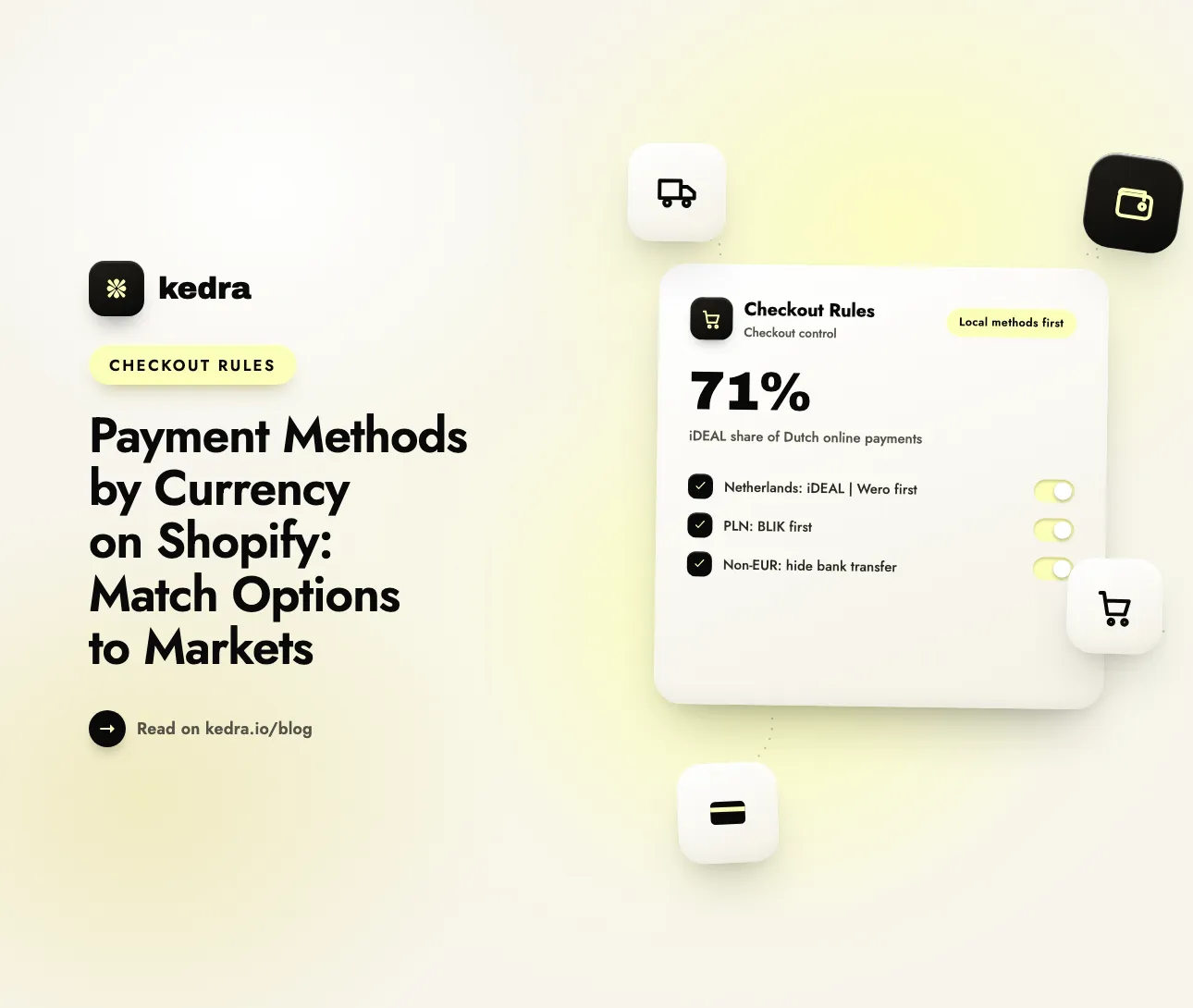
- Netherlands: iDEAL held 71% of Dutch online payments in 2025, against 8% for credit cards (Thuiswinkel.org, March 31, 2026).
- Germany: PayPal (28.7%) and purchase on invoice (26.1%) led 2025 online payment turnover among the 172 retailers in EHI’s online-payment panel, with direct debit third (14.4%) and credit and international debit cards fourth (13.7%) (EHI Retail Institute, May 5, 2026).
- Poland: shoppers paid with BLIK 1.4 billion times online in 2025, worth PLN 219 billion (BLIK, February 17, 2026).
- Sweden: Swish and buy-now-pay-later services such as Klarna are individually the most common ways to pay online, though card-based methods combined make up 64% of the methods Swedes used for online purchases (Sveriges Riksbank, March 12, 2026).
- United States: digital wallets took 40% of online transaction value in 2025, credit cards 32%, and debit cards 16% (Worldpay, April 20, 2026).
Worldpay’s head of research draws the lesson for merchants:
“We see different payment trends taking off in different markets. For merchants, it’s critical to understand the optimal payments mix that gets consumers through the checkout easily and keeps them coming back.” - Marco Chardi, head of research at Worldpay, March 2026
What does Shopify already filter by currency, and what is left to you?
Shopify Payments hides its own local methods when the country or currency does not match, and managed payment methods can reorder checkout methods for each buyer. Neither feature hides the methods most likely to break a multi-currency checkout: third-party gateways, manual methods, and cash on delivery.
Shopify’s managed payment methods page lists what it won’t activate or manage: card types, cash and cash on delivery, manual payment methods, gift cards, custom payment apps, and third-party provider integrations (Shopify Help Center, Managed payment methods). Shopify Payments never hides these methods by currency, and Shopify’s own Checkout Blocks app can do it only on Shopify Plus (Shopify Help Center, Customizing payment methods in Checkout Blocks), so on other plans these, plus method order, are yours to manage:
- Manual methods. If your bank transfer details only receive one currency, hide the method for every other checkout currency.
- Cash on delivery. COD follows the delivery country, not the currency, so key it to Country: shoppers in other eurozone countries also pay in EUR. See how to hide cash on delivery for international orders.
- Third-party gateways. Hide any provider that charges only in your store currency for shoppers paying in a foreign currency, but keep PayPal Express visible: it charges in the shopper’s currency when Shopify Payments or Adyen is your primary gateway.
- Method order. Managed payment methods doesn’t override an ordering you set yourself, so a reorder rule keeps the local favorite at the top whether the feature is on or off. For ranking strategy beyond currency, see how to reorder payment methods for higher conversions.
Shopify’s own help page still recommends a tool that no longer runs. The International payments page tells merchants who “want to encourage your customers to use multi-currency compatible payment methods” to “use Shopify Scripts to hide other payment providers for customers who have a foreign currency at checkout” (Shopify Help Center, International payments). Yet “As of June 30, 2026, Shopify Scripts has been deprecated,” and every published Script was deactivated (Shopify Help Center, Shopify Scripts).
Hiding payment providers by currency now runs through checkout extensibility. The Payment Customization Function API can hide, reorder, and rename payment methods, and its input includes the checkout currency and the buyer’s country (Shopify.dev, Payment Customization Function API). If your currency logic lived in a Script, migrate from Shopify Scripts to a checkout rules app to restore it.
Should you target payment rules by currency, country, or Shopify market?
Target by currency when the question is whether a method can charge in that money, and by country when the question is whether a method is local to the shopper. Combine both whenever they can disagree, and avoid building new logic on market IDs.
- Currency answers “can this method charge in this currency?” It is the right key for bank transfer and gateways that only receive your store currency. For a store priced in EUR, one condition, Currency not equal to EUR, covers every other currency at once. Where one currency maps to one market, such as PLN for Poland, Currency alone can also rank the local favorite.
- Country answers “is this method local here?” EUR spans many countries, so Currency alone cannot tell a German shopper from a Dutch one. Local methods that Shopify already limits to one country, such as iDEAL | Wero and Bancontact, can share one EUR ranking, because only the eligible method appears at each checkout. To rank a method offered across the eurozone, such as Klarna, first in Germany but not elsewhere, add a Country condition, the same approach as hiding payment methods by customer location.
- Currency and country together handle mismatches. Shopify’s TWINT page says customers “must be located in Switzerland and select CHF currency” (Shopify Help Center, TWINT), so a Swiss shopper paying in EUR, for example on a digital-only order or when your Switzerland market is priced in EUR, needs other methods ranked first.
- Shopify market is convenient for grouping, but Shopify warns that “Market IDs are no longer stable identifiers for targeting buyers” (Shopify.dev, Target buyers by country), and the payment function input marks its market field as deprecated (Shopify.dev, Payment Customization Function API). For new rules, use Country and Currency conditions rather than a Shopify market condition.
- User language is the key for renames, because method names can differ in each checkout language.
How do you set up payment methods by currency without code?
Kedra Checkout Rules turns Shopify’s payment customization functions into a no-code form: pick a rule type, add a Currency or Country condition, and save. Pairing methods with currencies is one of the simplest forms of Shopify checkout customization, and it works on every Shopify plan from Basic up.
This walkthrough builds the rules most multi-currency stores need, for a store priced in EUR:
- Copy the exact method names from a live checkout. Rules match names as the checkout shows them, and admin names under Settings → Payments can differ. Temporarily disable rename rules, run a checkout with a shipping address in each target country, because local methods such as iDEAL | Wero appear only there, and copy each name. The guide to finding the exact payment method name covers variations such as “PayPal” versus “PayPal Express Checkout”.
- Create a hide rule. In the app dashboard, click Create rule, choose Hide payment methods, name it “Hide EUR-only methods for non-EUR checkouts”, and set Rule status to Test.
- Choose the methods. Under Hide settings, select Hide selected payment methods and add, by checkout name, your bank transfer method and any third-party gateway that charges only in your store currency. Leave PayPal Express out of this rule.
- Add the Currency condition. Set Validation trigger to On condition and add Currency → Not equals to → EUR. The rule preview card shows the IF and THEN before you click Save.
- Rank the local favorites first. Create a Reorder payment methods rule, set Order by to Fixed ranking, and use Add payment method to put iDEAL | Wero at rank 1 and Bancontact at rank 2. Set Validation trigger to On condition and add Currency → Equals to → EUR. Because Shopify shows iDEAL | Wero only in the Netherlands and Bancontact only in Belgium, each country sees its own method first. Unranked methods keep their default order below.
- Add one rule per market. A reorder rule holds one ranking, so create a separate rule for each market that needs a different favorite, such as BLIK first for Currency → Equals to → PLN or Klarna first for Country → Equals to → Germany, and hide cash on delivery in its own rule with Country → Not equals to → your country. Use Add group with OR only when markets share a ranking; each group holds up to 5 conditions and each rule up to 5 groups, within your plan’s limit. If a hide rule removes a ranked method, the ranking has no effect on it.
- Test, then activate. Check out as
[email protected]with a shipping address in each target country, confirm the order summary shows that currency, then set Rule status to Active.
Which plan do you need, and what can’t an app change?
The Free plan runs 1 active payment rule with 1 condition, so it covers either the Currency hide rule from steps 2 to 4 or the reorder rule from step 5, not both at once. Starter ($8.99/month) raises the limits to 3 active rules and 3 conditions per rule, enough to run steps 2 to 5 together or to combine Currency and Country in one rule. Unlimited ($14.99/month) removes the rule cap, so it covers a reorder rule for every market plus a separate cash on delivery rule.
Three limits apply whichever Kedra plan you choose. Customizing the default Credit card (Shopify Payments) method in Kedra Checkout Rules requires Shopify Plus, and in the US and Canada, Shopify limits payment customizations on non-Plus stores to non-credit-card methods (Shopify Help Center, Checkout customization). Apps can’t rename methods that have logos as a name, such as Shop Pay, Apple Pay, and Google Pay, or any wallet, and they can remove wallets but not reorder them (Shopify.dev, About functions in payments); Shopify’s Checkout Blocks guide also names Klarna and PayPal as logo-named methods that can’t be renamed (Shopify Help Center, Customizing payment methods in Checkout Blocks). Inside Shop Pay’s own checkout, Shopify applies payment customizations only to the gift card field, so hide and reorder rules don’t change the payment methods shown there.
Pair my store’s currencies with the right payment methods - install Kedra Checkout Rules free →
What mistakes break currency-based payment rules?
Currency rules fail when they match the wrong method name or are tested the wrong way, and they backfire when they hide wallets or too many methods:
- Matching a renamed or translated name. Hide and reorder rules must use the original method name, not the name a rename rule displays. Where a method’s name differs by checkout language, add a User language condition.
- Testing with the currency selector alone. On one-page checkout with Shopify Payments or Adyen, physical-goods checkouts switch to the currency of the shipping address’s market, so a selector-only test can show the wrong payment list. Test with an address in each target country, and remember that a rule in Test status runs only for
[email protected]until you set it to Active. - Hiding wallets everywhere. Shopify warns that “hiding your accelerated checkout options might have a negative impact on your conversion rates” (Shopify Help Center, Checkout customization).
- Hiding too much. In Baymard Institute’s latest quantitative study of why US online shoppers abandon, 9% of those who abandoned for a reason other than “just browsing” said “There weren’t enough payment methods” (Baymard Institute, Cart Abandonment Rate Statistics, last updated September 22, 2025).
Kedra Checkout Rules: a Shopify checkout customizer
Kedra Checkout Rules is a Shopify checkout customizer built on Shopify’s checkout extensibility. The same no-code checkout customization that pairs methods with currencies also lets you customize your checkout with order limits and checkout validation rules, all set by condition.
For a deeper dive, see the best Shopify checkout rules apps for 2026.
Frequently Asked Questions
How do I show different payment methods based on currency in Shopify?
Set a currency for each market under Markets, activate the local methods you want through Shopify Payments, then add payment rules. A hide rule with Currency not equal to your store currency removes methods that only receive your store currency, such as bank transfer, and a reorder rule keyed to country or currency puts each market’s local favorite first.
Why doesn’t iDEAL, Bancontact, or BLIK show at my Shopify checkout?
Shopify shows these methods only when country and currency both match: iDEAL | Wero needs a Netherlands address and EUR, Bancontact needs Belgium and EUR, and BLIK needs a Polish address and PLN. The country must be an active market, and your Shopify Payments account must be in an eligible region; US, UK, and Canadian accounts can’t offer BLIK.
Do I need Shopify Plus to change payment methods by currency?
No. Public apps built on Shopify Functions, such as Kedra Checkout Rules, can hide, rename, and reorder payment methods by currency on the Basic plan and above. The exception is the default Shopify Payments credit card method: Kedra Checkout Rules needs Shopify Plus to customize it, and Shopify restricts card customization for non-Plus stores in the US and Canada.
Should I use a currency condition or a country condition?
Use currency for methods that only receive one currency, such as bank transfer, and country for methods offered in several countries that share a currency, such as ranking Klarna first in Germany, or for cash on delivery. Combine both when they can disagree: a Swiss shopper paying in EUR will not see TWINT, which requires Switzerland and CHF.
What replaced the Shopify Script that hid gateways for foreign currencies?
Payment customization functions replaced it. Shopify deactivated every published Script on June 30, 2026, including scripts based on Shopify’s multi-currency example that hid non-Shopify Payments gateways for foreign-currency checkouts. A checkout rules app rebuilds that logic as a hide rule with a Currency condition, no code required; leave PayPal Express out of it.
The bottom line: pair every currency with methods that fit it
Showing payment methods by currency comes down to a short checklist: know which methods each currency unlocks, let Shopify Payments gate its own local methods, and write rules for everything it leaves alone. Bank transfer, COD, third-party gateways other than PayPal Express, and method order are yours to manage.
The goal is the right methods for each currency, not fewer methods overall. 21% of US consumers abandoned an online cart in the previous 30 days because their preferred payment method was not available (PYMNTS Intelligence, September 16, 2026). Set up my first currency rule free with Kedra Checkout Rules and preview it in Test mode before real shoppers see it.