import { Image } from ‘astro:assets’;
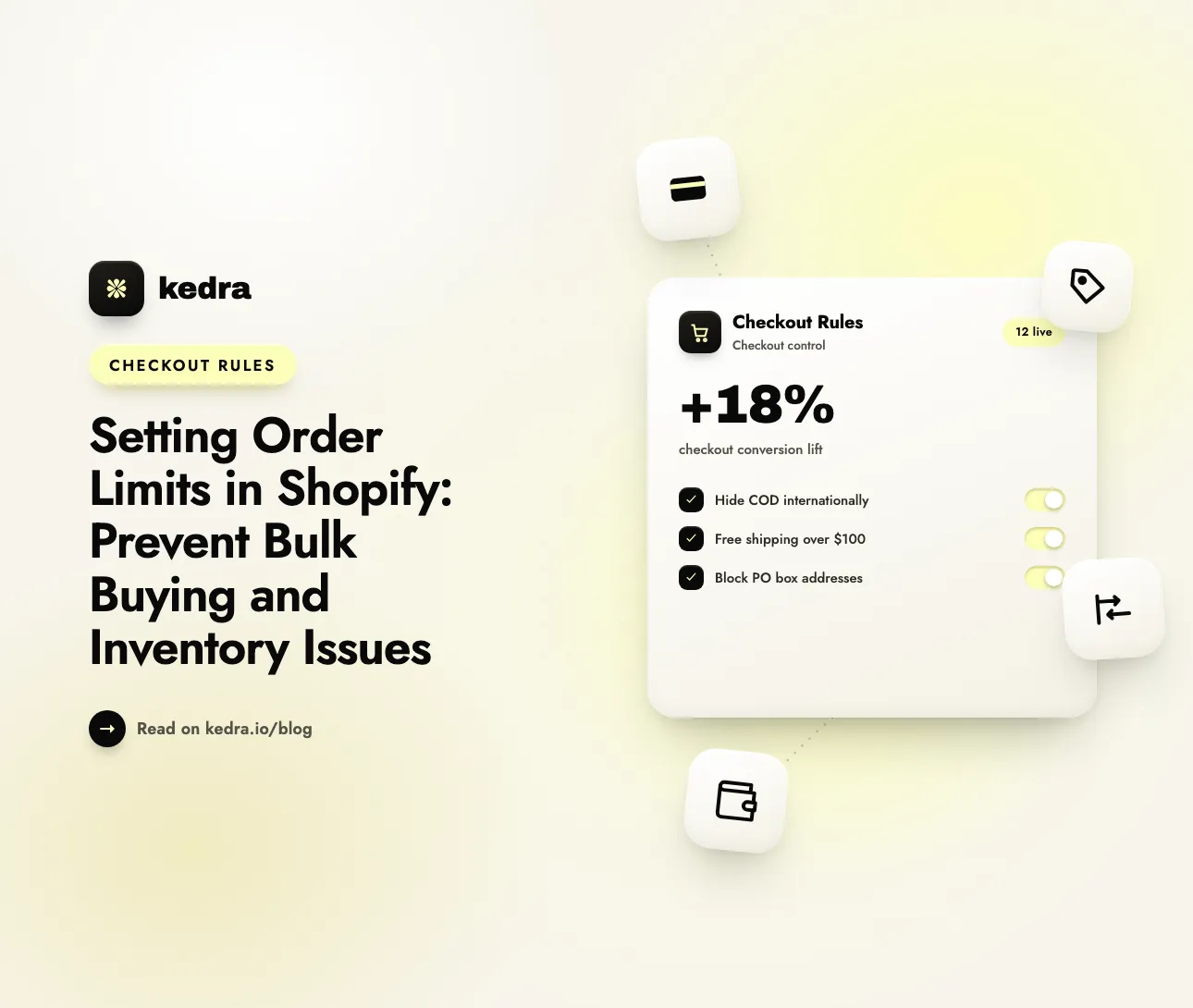
To set order limits in Shopify, use a checkout rule that caps the quantity or total value a single customer can buy - by product, variant, collection, or customer tag. Order limits keep bots and resellers from clearing your stock in one purchase, so genuine customers get a fair shot and your inventory planning stays predictable.
The Inventory Control Crisis in Modern E-Commerce
The contemporary digital marketplace has evolved into a high-velocity battlefield where inventory management is no longer merely a logistical concern-it is a central pillar of brand survival, customer experience, and financial integrity. For merchants operating with limited stock, particularly those in the fashion, collectibles, or high-demand consumer goods sectors, the ability to control who buys what, and in what quantity, is the defining factor between a profitable drop and an operational catastrophe.
In 2024 and moving into 2025, the landscape of e-commerce has been fundamentally altered by the proliferation of automated purchasing agents (bots), the rise of aggressive reseller markets, and the increasing complexity of global logistics. The romantic notion of a “sold-out” shop is often overshadowed by the grim reality of inventory hoarding, where genuine brand enthusiasts are alienated by stockouts caused by bulk buyers, while merchants suffer from the “gray market” erosion of their brand equity.

Furthermore, the operational friction of shipping logistics-specifically the incompatibility of major private carriers like FedEx and UPS with Post Office (PO) Box addresses-creates a silent hemorrhage of revenue through failed deliveries and return fees. When combined with the financial risks associated with insecure payment methods like Cash on Delivery (COD) for high-value items, the modern Shopify merchant faces a trifecta of threats: inventory depletion by bad actors, logistical failures due to address incompatibility, and financial loss through fraud.
The Solution: Kedra Checkout Rules
The Kedra Checkout Rules app for Shopify is a powerful tool that allows you to set precise order limits and restrictions, giving you granular control over your inventory and checkout process. With our app, you can:
- Set quantity limits: Prevent customers from ordering more than a certain number of items.
- Restrict shipping to PO Boxes: Avoid failed deliveries and return fees.
- Disable Cash on Delivery (COD) for specific products or locations: Reduce the risk of fraud.
- And much more!
Kedra Checkout Rules is the ultimate solution for Shopify merchants who want to take control of their inventory and protect their bottom line.

Why You Need Order Limits
Setting order limits is essential for any Shopify store that sells limited-stock items. Here are just a few of the benefits:
- Prevent stockouts: By limiting the number of items a customer can purchase, you can ensure that more of your customers have a chance to buy your products.
- Stop resellers: Resellers often use bots to buy up large quantities of limited-stock items, which they then sell at inflated prices. Order limits can help you to stop resellers in their tracks.
- Improve customer experience: When your products are always sold out, it can be frustrating for your customers. Order limits can help you to create a more positive customer experience.
- Increase profits: By preventing stockouts and stopping resellers, you can increase your sales and profits.
How to Set Order Limits with Kedra Checkout Rules
Setting order limits with Kedra Checkout Rules is easy. Simply install the app from the Shopify App Store and create a new rule. You can set limits based on the number of items in the cart, the total value of the cart, or the customer’s location.
For more information, check out our app on the Shopify App Store: Kedra Checkout Rules
How Order-Limit Rules Work in Kedra Checkout Rules
Order limits in Kedra Checkout Rules are conditional checkout rules: you define a condition (for example, “quantity of this product is greater than 2”) and an action (block checkout with a message). The app evaluates every cart against your active rules at checkout and stops any order that violates them. The main limit types you can configure include:
- Quantity limits per product or variant: Cap how many units of a specific product or variant a customer can buy in a single order - ideal for one-per-customer drops or “max 3 per order” restocks.
- Cart-wide quantity limits: Set a maximum total number of items across the whole cart, regardless of which products it contains.
- Order value limits: Enforce a minimum or maximum cart total. Minimums support wholesale purchasing thresholds, while maximums prevent oversized orders that drain stock or signal fraud.
- Collection-based limits: Apply a quantity cap to any product in a chosen collection, so an entire category of limited items is protected by a single rule.
- Customer-based limits: Use customer tags to give trusted or wholesale buyers higher limits while holding new or anonymous shoppers to a tighter cap.
Because Kedra runs on Shopify’s native checkout validation Functions, these limits are enforced server-side. That means they hold up across Shop Pay, Apple Pay, Google Pay, and other express checkout paths - not just the standard checkout page where client-side scripts could be bypassed. You can review the full list of supported conditions on the Kedra Checkout Rules app page.
Common Use Cases for Order Limits
Order limits solve several distinct problems depending on what you sell and how you sell it:
- Limited drops and collectibles: Cap units per customer so one buyer - or one bot - can’t clear the entire run. This is the same logic behind flash sale checkout protection that limits quantities and blocks bots.
- Wholesale minimum order quantities: Set a minimum cart quantity or value so wholesale accounts meet the thresholds your pricing assumes.
- Fair-access launches: Keep resellers from hoarding inventory so genuine fans and repeat customers can actually complete a purchase.
- High-demand restocks: Apply a temporary per-customer cap when a popular item returns, then relax it once demand normalizes.
- Thin-margin and loss-leader items: Prevent someone from buying your entire discounted stock in a single bulk order.
Setting Up Order Limits Step by Step
- Install the app. Add Kedra Checkout Rules from the Shopify App Store - there’s a free plan, and paid plans start at $6.99/month.
- Choose your condition type. Decide whether you’re limiting by quantity, cart value, collection, or customer segment. You can pair order limits with related rules in the same app, such as maximum order value caps for Cash on Delivery or restrictions that block PO Box shipping on large items.
- Set your threshold. Enter the maximum quantity or value you want to allow - for example, “no more than 2 units per order” or “cart total under $5,000.” Not sure what number to pick? Our free order limit calculator suggests a fair cap in seconds.
- Scope the rule. Target it to a specific product, variant, collection, or customer tag so the limit only applies where you intend.
- Write a clear checkout message. Tell the customer why they’re blocked and what to do - a specific message like “Limited to 2 per customer during launch” converts far better than a generic error.
- Test before going live. Place test orders that both pass and violate the rule, and check express checkout paths like Shop Pay to confirm the limit holds everywhere.
Customize your Shopify checkout with Kedra Checkout Rules
Kedra Checkout Rules is a Shopify checkout customizer purpose-built for merchants who need order limits. Using Shopify’s checkout extensibility, it lets you set minimum and maximum quantities or cart values, block bulk-buying bots, and otherwise customize your checkout - hiding, renaming, and reordering payment and shipping methods. It’s real checkout customization with no code.
Learn more about how Shopify checkout customization compares to native Plus tools.
Frequently Asked Questions
What’s the difference between a quantity limit and an order value limit?
A quantity limit caps how many units a customer can buy - per product, per variant, or across the whole cart. An order value limit caps (or sets a minimum for) the cart’s total dollar amount. Many stores use both: a per-product quantity cap plus a maximum cart value for extra protection.
Can I set different order limits for wholesale and retail customers?
Yes. Kedra Checkout Rules reads Shopify customer tags, so you can give tagged wholesale accounts higher limits - or a minimum order quantity - while holding new or anonymous shoppers to a tighter per-order cap. You create one rule per segment and run them at the same time.
Will order limits stop bots and resellers?
Order limits make bulk hoarding much harder by capping how much any single order can contain. Because Kedra enforces them server-side through Shopify Functions, bots can’t slip past the cap through express checkout. Pair limits with other checkout validation rules for stronger protection against automated buying.
Do order limits work with express checkout like Shop Pay?
Yes. Kedra Checkout Rules run on Shopify’s native checkout validation Functions, which apply server-side across Shop Pay, Apple Pay, Google Pay, and standard checkout. A limit you set will hold on every checkout path, not just the main checkout page.
How much does Kedra Checkout Rules cost?
Kedra Checkout Rules has a free plan that runs 1 active rule per rule type (payment, shipping, validation and shipping discount) with 1 condition per rule, plus 7 days of checkout analytics. Paid plans add more rules and conditions, full analytics and custom checkout error messages: Starter is $6.99/month, Starter Plus is $8.99/month (adds post-purchase upsells) and Unlimited is $12.99/month (unlimited rules and conditions). Each paid plan has a 7-day free trial and saves 30% when billed yearly. You get quantity limits, order value rules, collection and customer-based conditions, PO Box and COD restrictions, and more - all without writing code or upgrading to Shopify Plus.
Don’t let bulk buyers and inventory issues hurt your business. Install Kedra Checkout Rules today and take control of your Shopify store!