Phone verification for COD sends a one-time code to the shopper’s number before a cash-on-delivery order is confirmed, so fake numbers and low-intent orders drop out instantly. Store operators who add OTP verification typically report a 15-42% fall in fake COD orders and return-to-origin (RTO) losses, turning cash on delivery from a liability back into a conversion driver.
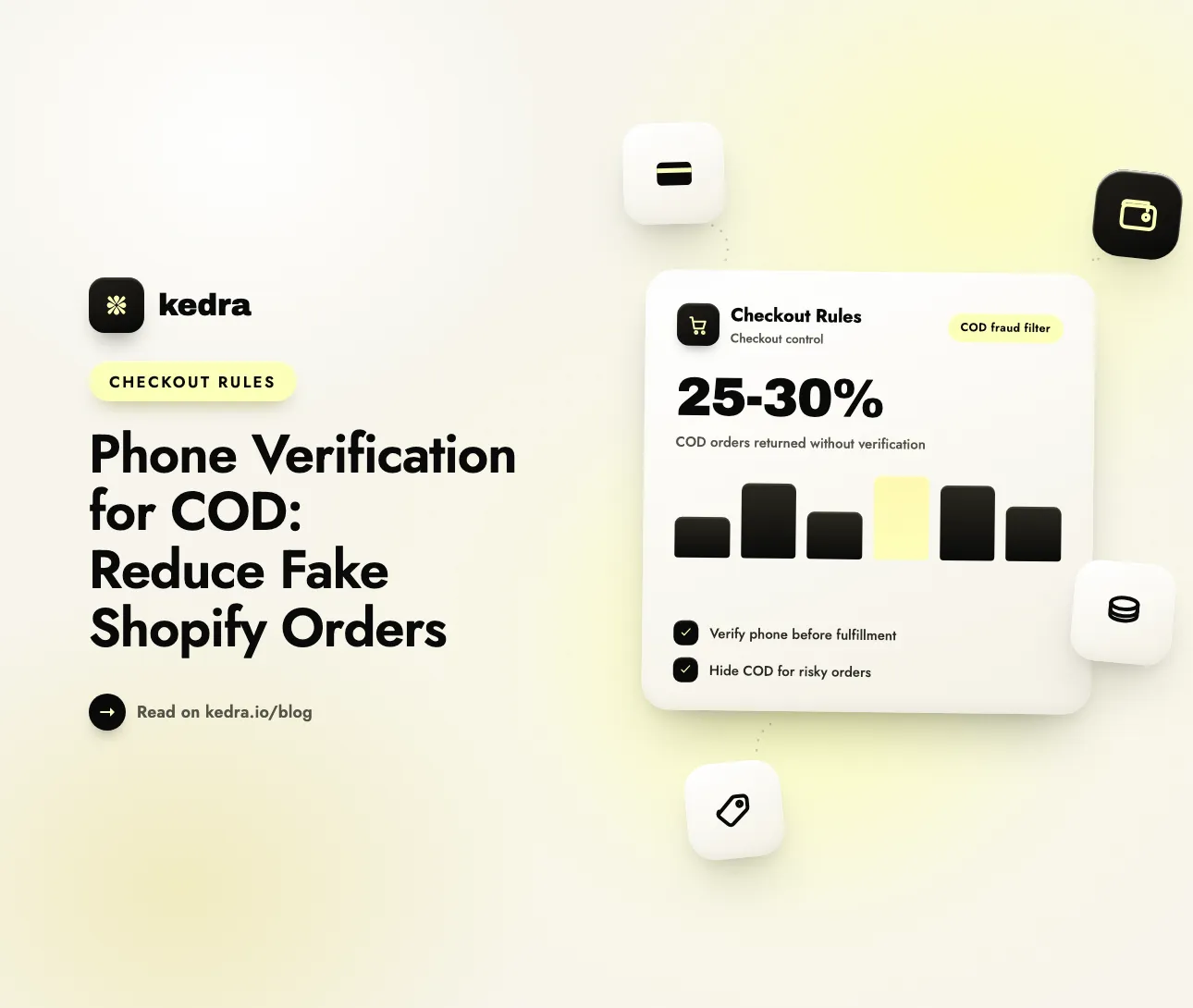
Cash on delivery is the payment method that quietly bleeds margin. It lifts conversion at checkout, then hands you a stack of refused parcels, wasted shipping, and orders placed with junk phone numbers. According to a Razorpay guide citing ET Prime Research (2024), 60-65% of all Indian e-commerce orders are placed via COD - yet those same COD orders carry a 25-30% RTO rate versus just 2-3% for prepaid. Phone verification is the cheapest, highest-leverage filter you can add.

What is phone verification for COD?
Phone verification for COD is a checkout step that confirms the buyer controls the phone number on the order before you ship it. When a shopper selects cash on delivery, they receive a one-time password (OTP) by SMS or WhatsApp and must enter it to complete the order. Orders placed with fake, mistyped, or throwaway numbers never confirm, so they never reach your courier.
The mechanism is simple but the effect is outsized. As one Shopify fraud guide puts it, “Fake orders aren’t a fact of life you have to accept as the price of offering cash on delivery.” A ten-second verification step removes the easiest form of COD abuse - the shopper who places an order with a made-up number and no intent to pay - before it costs you a round trip in shipping.
Why fake COD orders are so expensive
Every refused COD parcel costs you twice: once to ship out and once to ship back, plus handling, restocking, and the working capital tied up while the item is in transit. A RedSeer report estimates Indian e-commerce businesses lose over ₹20,000 crore annually to high RTO and failed deliveries. Fashion and general merchandise are hit hardest, with COD RTO rates reaching 35-40%.
Fraud sits on top of that. Razorpay’s research estimates roughly 8-10% of COD orders are fraudulent - a mix of address abuse, serial refusers, and bots placing bulk orders during drops. Because COD collects no payment upfront, there is no chargeback trail and no card to decline; the only defense is confirming the order is real before it ships.
A Razorpay guide explains the underlying behavior well:
“COD lowers the psychological barrier to placing an order. Shoppers can add to cart and complete checkout without the friction of entering payment details. This drives impulse purchases, which is good for conversion rates but contributes to higher RTO when buyers change their minds before delivery.”
Phone verification reintroduces exactly enough friction to filter the impulse-and-abandon orders while keeping genuine buyers.
How much do fake orders actually drop with phone verification?
Independent stores and verification vendors consistently report double-digit reductions after enabling OTP. The exact figure depends on your category and how many risky orders you already receive:
- OTP, IVR, or WhatsApp verification typically cuts fake orders and RTO by 15-35%.
- One D2C brand documented a 35% reduction in fake COD orders within six weeks of turning on OTP.
- A Shopify store reported a 40% drop in fake orders after enabling verification.
- Some vendors cite reductions of up to 42-50% for high-RTO catalogs.
Treat the higher numbers as ceilings, not guarantees - a store with clean traffic has less fraud to remove than a fashion brand running flash sales in Tier-2 markets. The direction, though, is consistent across every source: verification removes a meaningful share of the orders that would otherwise become RTO.
COD verification tactics compared
Phone OTP is the strongest single lever, but it works best layered with checkout-side rules. Here is how the common tactics stack up:
| Tactic | What it stops | Friction added | Best for |
|---|---|---|---|
| Phone OTP verification | Fake/mistyped numbers, low-intent impulse orders | ~10 seconds | Every COD store |
| Confirmation calls | High-value or high-risk orders | High (manual) | Selective, expensive orders only |
| Hide COD for risky segments | First-time buyers, high-RTO regions | None (invisible) | Reducing risky COD before it’s placed |
| COD order limits | Bulk/scalper orders, oversized carts | None | Flash sales, inventory protection |
| Address/email validation | PO boxes, disposable emails, bad addresses | None | Filtering junk order data |
The most resilient setup pairs OTP (which confirms the buyer) with checkout rules (which stop the riskiest COD orders from ever being placed). That combination shrinks both the fraud you catch and the fraud you never have to process.
How to reduce fake COD orders on Shopify, step by step
You do not need Shopify Plus for any of this. A layered COD defense on Shopify looks like this:
- Add an OTP verification step for COD orders. Use a dedicated Shopify COD/OTP verification app so a code is sent by SMS or WhatsApp when the shopper picks cash on delivery. Keep the flow short - one field, one code - so genuine buyers barely notice it.
- Hide COD for your highest-risk segments. New customers with no order history drive a disproportionate share of RTO. Restricting COD to returning or verified customers removes much of the risk before verification even runs. See our guide to hiding cash on delivery for international orders for the same conditional pattern applied to geography.
- Cap COD with order limits. Bulk COD orders during a drop are often bots or resellers. Setting a maximum cart value or quantity for COD - a classic use of order limits in Shopify - stops inventory-hoarding orders you’d never collect on.
- Validate the order data. Block PO boxes, disposable email domains, and incomplete addresses so bad orders fail before fulfillment rather than after a failed delivery.
- Monitor and blocklist repeat offenders. Track which phone numbers and addresses refuse delivery, and prevent them from placing future COD orders.
Steps 2-4 are pure checkout configuration - no code, no theme edits - and they’re exactly what a checkout customizer handles.
Backing phone verification with Kedra Checkout Rules
Phone verification confirms the shopper; Kedra Checkout Rules, a no-code Shopify checkout customizer (free plan available) built on Shopify’s checkout extensibility, controls which COD orders are allowed in the first place. Together they reduce both the volume of risky COD orders and the fraud that slips through.
Here’s how to configure the checkout-side layer:
- Hide COD for first-time customers. Create a payment rule that shows cash on delivery only to customers tagged as returning or verified, and hides it for everyone else. New, unverified buyers are pushed toward prepaid - the single biggest RTO reduction you can make.
- Restrict COD to reliable regions. If specific provinces or postal ranges drive your worst RTO, hide COD for those shipping addresses while keeping it everywhere else.
- Set COD order limits. Cap the cart value or item quantity that qualifies for cash on delivery, so a suspicious bulk order can’t choose COD during a flash sale. This is standard checkout customization: a maximum-order-value condition attached to the COD payment method.
- Validate risky orders. Add conditions that block PO box addresses or disposable email domains at checkout, so junk orders fail immediately instead of becoming a failed delivery.
Because every rule runs on Shopify’s Payment Customization and Validation Functions, it holds server-side across Shop Pay, Apple Pay, and Google Pay - not just the standard form. You customize your checkout with plain conditions in a few minutes, then let phone verification handle confirmation on the orders that remain.
Want to see how this compares to native tooling? Read the best Shopify checkout rules apps for 2026 for a feature-by-feature breakdown.
No-code checkout customization with Kedra Checkout Rules
Kedra Checkout Rules is a Shopify checkout customizer built on Shopify’s checkout extensibility - the upgrade-safe framework that replaced checkout.liquid and Scripts. It delivers no-code checkout customization: hide, rename, and reorder payment and shipping methods, validate risky orders, and set order limits, so you can customize your checkout with conditional rules instead of developer time.
For a deeper dive, see how Shopify checkout customization compares to native Plus tools.
Frequently Asked Questions
Does phone verification hurt conversion on COD orders?
Genuine buyers rarely abandon over a ten-second OTP step, and the orders you do lose are overwhelmingly the fake and low-intent ones you don’t want to ship. Most stores see net-positive economics: a small dip in raw order count, a much larger drop in RTO and wasted shipping, and higher realized revenue per order shipped.
Is phone verification enough on its own to stop COD fraud?
It’s the strongest single filter, but not a complete defense. OTP confirms the buyer controls the number; it doesn’t stop a verified shopper from refusing delivery or a reseller from bulk-buying. Pair verification with checkout rules that hide COD for risky segments and cap COD order limits to close those gaps.
Do I need Shopify Plus to add COD verification and rules?
No. OTP verification apps and checkout customization apps like Kedra Checkout Rules work on Basic, Shopify, and Advanced plans. They run on Shopify’s checkout extensibility - the same Functions framework Plus uses - so you get conditional COD control without a Plus upgrade or custom code.
What’s the difference between OTP verification and a confirmation call?
OTP verification is automatic and instant - a code sent to every COD shopper. Confirmation calls are manual, so they’re best reserved for high-value or flagged orders rather than every order. Verification scales to your full order volume; calls don’t. Many stores use OTP for all COD orders and calls only for the highest-risk ones.
How much can phone verification realistically reduce fake COD orders?
Reported reductions cluster between 15% and 42%, with some high-RTO catalogs citing up to 50%. Your result depends on category and traffic quality - a flash-sale fashion brand has far more fraud to remove than a niche store with loyal buyers. Expect a meaningful, measurable drop rather than a fixed percentage.
Start reducing fake COD orders today
Cash on delivery doesn’t have to be a margin leak. Add phone verification to confirm real buyers, then use checkout rules to keep the riskiest COD orders from ever being placed. Hide COD for first-time customers, cap it with order limits, and validate junk addresses before they cost you a round trip.
Install Kedra Checkout Rules free to build the checkout-side layer in minutes - no code, no Shopify Plus - and pair it with an OTP verification flow to cut fake COD orders and RTO for good.