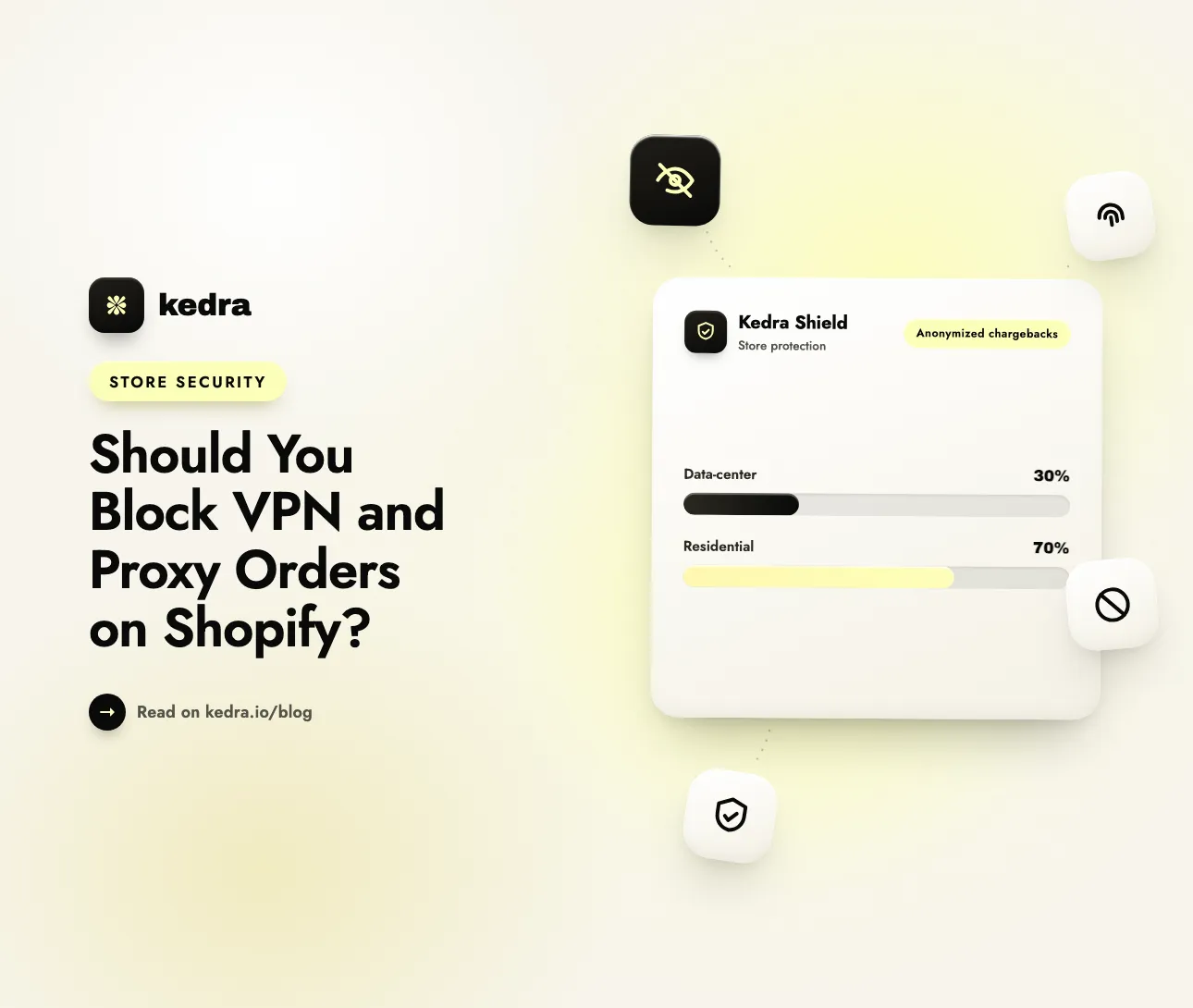
For most Shopify stores, you should not block all VPN and proxy orders — blanket bans turn away millions of legitimate, privacy-conscious shoppers. The smarter move is to block only high-risk anonymized traffic (Tor, data-center proxies, and VPN orders paired with other fraud signals) using risk-based rules rather than a single on/off switch.
A VPN or proxy order is a purchase placed through a connection that deliberately hides the shopper’s real IP address and location — routing the request through a virtual private network, a proxy server, or the Tor network so your fraud filters see the intermediary instead of the customer.
The question is hard because anonymized connections really are a fraud signal. In an August 2026 analysis of chargeback data, fraud-intelligence firm MaxMind found that “close to half of chargebacks in our analysis were associated with some form of anonymizer, versus roughly a fifth of ordinary transactions.” The catch: the same tools are used by tens of millions of ordinary shoppers, so a blanket block trades a fraud problem for a conversion problem.

On this page
- What counts as a VPN or proxy order?
- Why blocking every VPN order backfires
- When you should block VPN and proxy orders
- The decision framework: risk-based, not all-or-nothing
- Industry-specific recommendations
- How VPN and proxy detection actually works
- How to block risky orders with Kedra Shield
- Frequently asked questions
What counts as a VPN or proxy order?
A VPN or proxy order is any order where the connection hides the shopper’s true origin. There are four common types, and they carry very different risk levels:
- Commercial VPN — a consumer app (NordVPN, Surfshark, ExpressVPN) that routes traffic through a data-center IP in another city or country. Extremely popular and mostly legitimate.
- Data-center proxy — a raw server IP, not tied to any home ISP. Cheap and disposable, which is why most bad bots use them and why they are the easiest anonymizer to blocklist.
- Residential proxy — traffic laundered through a real person’s home internet connection, so it looks like an ordinary customer. The hardest to detect and the one fraudsters prefer.
- Tor — the onion router, which bounces traffic through multiple relays for near-total anonymity. Rare in normal e-commerce and heavily associated with abuse.
The distinction matters for the block-or-allow decision. Tor and data-center proxies skew heavily toward automation and fraud — see our guide on why anonymous Tor access is a red flag for your Shopify store. Commercial VPNs and residential proxies are where legitimate and malicious traffic overlap, so they demand nuance rather than a hard block. For the deeper attacker’s-eye view, our companion post explains exactly why fraudsters love VPNs.
Why blocking every VPN order backfires
Blocking every VPN order backfires because VPN use is now mainstream behavior, not a fraud tell. According to Security.org’s 2026 research into VPN usage (updated March 18, 2026), only 54% of Americans said they don’t use a VPN — meaning roughly 46% do, up sharply from the year before, when 61% were non-users. Globally, Forbes Advisor reports about 31% of all internet users use a VPN.
Crucially, these are ordinary customers. Security.org found that “nearly half of internet users use VPNs for general security reasons, like avoiding identity theft, while an additional 40 percent used VPNs for general privacy reasons… About a third used VPNs on public Wi-Fi.” Half of all VPN users run one for personal reasons only. Block them all, and you are shutting the door on nearly half your potential U.S. market.
The financial case against over-blocking is even starker. Wrongly rejected good orders — “false declines” — already cost merchants far more than fraud itself. The Datos Insights report E-Commerce Fraud Landscape and Trends (May 2024) estimates the industry-average false-decline rate is 1.51% of annual sales, representing “nearly US$175 billion in 2024, increasing to US$265 billion by 2027.” The same report pegs actual e-commerce fraud losses at nearly US$29 billion for 2024 — so merchants lose roughly six times more to over-caution than to the fraud they are trying to stop.
False declines are also common and costly to loyalty. PYMNTS Intelligence reported in October 2024 that “56% of U.S. customers have experienced a false payment decline in the past three months.” And the damage sticks: Signifyd’s data shows that among loyal customers with at least three prior approved orders, a false decline is followed by “a 65% decline in the number of orders… and a 16% decline in their average order value,” while “27% do not return to the retailer at all.”
As Digital Element’s Vinod Kashyap put it in August 2025, “Blocking every VPN may reduce some risk, but it also disrupts legitimate users, damages conversion rates, and erodes trust. Allowing all VPN traffic creates an open door for fraud, account abuse, and compliance risk.” Neither extreme is the answer.
Want to see which anonymized orders your store is already getting before you decide anything? Explore what Kedra Shield flags and blocks — its analytics show you the real mix of VPN, proxy, and country traffic hitting your store.
When you should block VPN and proxy orders
You should block anonymized orders when the connection type is overwhelmingly abusive or when a VPN pairs with other fraud signals. The evidence for targeted blocking is strong:
- Anonymizers cluster in chargebacks. MaxMind’s 2026 chargeback study found anonymizers in close to half of chargebacks versus roughly a fifth of clean orders, and that “of the chargeback-reported transactions that were anonymized, at least 70% traced to residential proxies.”
- The infrastructure is now central to attacks. Spur’s 2026 IP Intelligence Study (May 2026) reported that “94% of organizations report VPNs or residential proxies are involved in security incidents.”
- Card testing is exploding. Signifyd’s 2026 State of Fraud Report found “card-testing attacks surged 175% year over year,” and this proxy-rotated probing of stolen cards almost always arrives behind anonymized IPs. Learn to spot it in our guide to card-testing attacks on Shopify.
Two connection types justify a near-automatic block for most physical-goods stores: Tor (very little legitimate retail use) and raw data-center proxies (the calling card of bots). Beyond those, treat a VPN as one input among many — never the sole reason to decline. The orders worth blocking are the ones stacking multiple high-risk order indicators at once.
The decision framework: risk-based, not all-or-nothing
The right approach is risk-based scoring: block the anonymizers that are almost always abusive, flag the ambiguous ones for review, and let clean VPN traffic through. Rapyd’s fraud and risk team states it plainly: “Fraud prevention isn’t one-size-fits-all, and blocking every VPN user isn’t a long-term solution,” and “Don’t block based on VPN alone — look for multiple red flags before declining a transaction.”
Here is a practical decision framework you can apply to your own store:
- Hard-block the worst connection types. Block Tor and known data-center proxy ranges outright if you ship physical goods. Legitimate customers almost never reach checkout this way.
- Score, don’t ban, commercial VPNs. Allow VPN orders by default, but raise their risk score so they need corroboration before shipping high-value items.
- Stack signals before you decline. Block only when a VPN or proxy combines with red flags — billing/shipping mismatch, a brand-new account, a rushed high-value first order, a country you don’t serve, or ISP and ASN patterns that signal fraud.
- Layer geography. If you ship to a defined set of markets, country and city blocking removes far more risk than VPN blocking alone, and with fewer false positives.
- Always show a friendly path back. When you do block, display a clear message explaining why and how to proceed (disable the VPN, or contact support) so a genuine shopper isn’t lost silently.
- Review and tune weekly. Watch your blocked-traffic logs. If real customers are getting caught, loosen the rule — over-blocking is the more expensive mistake.
Industry-specific recommendations
Your fraud exposure — and therefore how aggressively you should block — depends heavily on what you sell. Payment-fraud attack rates vary dramatically by category. Sift’s Q1 2026 Digital Trust Index (March 2026) reported that “travel and ticketing platforms recorded the highest average payment fraud rates in 2025” at 4.85%, while general digital commerce sat at just 1.94%. Cost compounds the risk: LexisNexis Risk Solutions’ 2025 True Cost of Fraud study found “US merchants incurring an average cost of $4.61 for every $1 of fraud.”
Use this table to set your default stance, then tune with the framework above:
| Store type | Anonymized-order risk | Recommended stance |
|---|---|---|
| Digital goods, gift cards, software | Very high — fraudulent digital-goods value rose 162% from a $10.4B base in 2025 | Aggressive: block Tor and data-center proxies; score VPNs strictly; verify before delivery |
| Electronics, luxury, high-ticket | High — resale value attracts card testing | Aggressive on Tor/proxies; manual review for VPN + high-value first orders |
| Cross-border / international | High — card fraud is “ten times higher” outside the EEA where SCA isn’t required | Layer country blocking; treat VPN + mismatched country as a strong flag |
| Apparel, cosmetics, home goods | Moderate — most-disputed chargeback categories per Sift, but much is friendly fraud VPN blocking won’t stop | Block Tor/proxies; rely more on address and identity checks than VPN blocking |
| Everyday consumer goods, low-ticket | Lower — thin margins for fraudsters | Conservative: block Tor only; leave commercial VPNs alone to protect conversion |
| Content, media, memberships | Lower purchase risk, higher scraping risk | Focus on bot and content protection over order blocking |
The pattern is clear: the higher your resale value and cross-border exposure, the more a targeted block pays off. For low-margin, domestic, everyday goods, the false-decline math usually argues against anything more than blocking Tor.
How VPN and proxy detection actually works
Detection works by checking each visitor’s IP against reputation databases and connection fingerprints — but the reason blanket IP blocking fails is that the riskiest traffic is engineered to look ordinary. Data-center proxies are easy: they belong to hosting providers, not ISPs, so they can be blocklisted on sight. Residential proxies are the problem. As DataDome explains, residential proxy IPs are “seen as high-quality and are harder to blocklist for security solutions,” because they route through real home connections.
The scale is enormous. Lumen’s Black Lotus Labs (July 2026) “tracks nearly 20 million distinct IPs per day across more than 30 malicious proxy botnet clusters” and warns that “residential proxies largely bypass standard detections, such as reputation-based blocking… anti-fraud defenses and geo-blocking.” Infoblox’s June 2026 research adds that “residential proxies produce laundered (disguised) traffic — the destination believes it knows exactly who is connecting, but it is wrong,” and that over 65% of its enterprise customers’ networks queried residential-proxy domains in 2026.
This is why detection quality matters more than an on/off toggle. DataDome’s 2024 Global Bot Security Report found that the most successful bots impersonated Chrome and connected through residential proxies — and that only 15.82% of them were detected, meaning roughly 84% of sites let that traffic straight through. A tool that “simply blocks proxy IPs” both misses the dangerous residential traffic and catches innocent commercial-VPN users. Effective screening weighs IP reputation plus fingerprints, headers, and behavior — the difference between server-side and client-side blocking is part of that picture too.
How to block risky VPN and proxy orders with Kedra Shield
Kedra Shield gives Shopify merchants risk-based control over anonymized traffic without touching code, so you can apply the framework above in minutes instead of writing IP rules by hand. It detects and blocks VPN, proxy, and Tor connections, layers in country/city/IP blocking, and shows you exactly who was blocked and why.
Here is how to set it up the balanced way:
- Install Kedra Shield from the Shopify App Store — there’s a free plan to start.
- Enable VPN & proxy blocking, and turn on Tor blocking if you ship physical goods. This handles the two connection types that are almost always worth blocking outright.
- Set your geography with the country and city blocker — whitelist the markets you actually serve, or blacklist high-risk regions, to cut cross-border exposure.
- Add data-center IP ranges tied to known bot activity to the IP blocker, and keep commercial-VPN traffic flowing so you don’t lose legitimate shoppers.
- Customize the block message so a privacy-conscious customer who gets caught knows how to proceed instead of abandoning silently.
- Watch the blocked-visitor and fraud-order analytics each week — the dashboard shows blocked IPs, locations, and reasons — and loosen any rule that is catching real customers.
For a deeper walkthrough of the settings, see our full guide on how VPN and proxy blocking strengthens your Shopify store security. Because Kedra Shield surfaces the data behind every block, you tune toward the risk-based middle ground the research recommends — stopping the anonymized orders that drive chargebacks and disputes while keeping conversions high.
Install Kedra Shield free on the Shopify App Store and start seeing (and scoring) your anonymized traffic today.
Frequently Asked Questions
Is it legal to block VPN and proxy users on my store?
Yes. You control who can access and buy from your store, and blocking or restricting traffic by connection type, IP, or country is legal for private businesses. The practical limit is commercial, not legal: block too broadly and you lose legitimate customers. Combine blocking with a clear on-screen explanation so blocked shoppers understand why.
Will I lose customers if I block VPN orders?
Almost certainly, if you block all of them. Security.org’s 2026 data shows roughly 46% of Americans use a VPN, most for ordinary privacy and security reasons. A blanket block treats those shoppers as fraudsters. Blocking only Tor, data-center proxies, and VPN orders that carry additional fraud signals protects revenue while still cutting risk.
Do VPN and proxy orders always mean fraud?
No. As Digital Element states, “VPN usage alone does not indicate fraud.” Many customers use a VPN on public Wi-Fi, while traveling, or simply for privacy. MaxMind’s data does show anonymizers are far more common in chargebacks than in clean orders, so a VPN raises the risk — but it should be one signal among several, never an automatic decline.
Should I block Tor traffic on Shopify?
For most stores selling physical products, yes. Tor sees very little legitimate retail use and is heavily associated with fraud and abuse, so blocking it removes risk with minimal downside. The trade-off is different for stores serving privacy-sensitive or censored audiences. See our dedicated guide on when Tor access is a red flag for the full decision.
Can Shopify’s built-in fraud analysis detect VPN and proxy orders?
Shopify’s native fraud analysis flags some risk signals but does not give you granular control to block visitors by VPN, proxy, Tor, country, or IP before checkout. A dedicated app like Kedra Shield adds that visitor-level layer, letting you enforce the connection-type and geographic rules Shopify’s built-in analysis leaves to manual review.
The bottom line
Should you block VPN and proxy orders on Shopify? Block the traffic that is almost always abusive — Tor and data-center proxies — and score everything else. Anonymized connections show up in nearly half of chargebacks, so ignoring them is expensive; but with roughly 46% of Americans on a VPN and false declines costing six times more than fraud, blanket-blocking is more expensive still. The winning move is risk-based rules that catch the dangerous orders and wave the genuine ones through.
Kedra Shield makes that balance practical: detect VPN, proxy, and Tor traffic, layer country and IP controls, and see the data behind every block so you can tune it to your store.
Get Kedra Shield on the Shopify App Store and turn anonymized-order risk into a decision you control.